
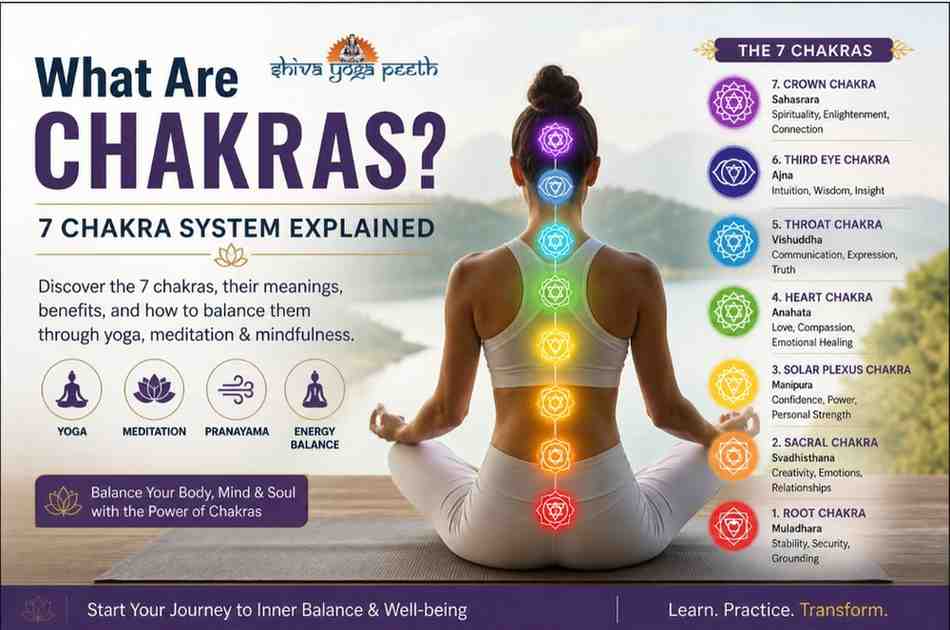
Chakras are significant aspects within the practice of yoga and holistic health, where they aid in ensuring harmony in the synchronisation between body, mind, and soul. For those individuals who seek to explore the world of yoga, it is crucial to learn about chakras since this is the way by which they would get to know themselves. It is impossible to stress the significance of the chakra in ancient Indian society.
It is equally important for those individuals who plan to take yoga certification classes in India, since Shiva Yoga Peeth puts special emphasis on learning the basics of yoga as well as energy healing and meditation practices.
What Is the Chakra Meaning in Yoga?
The chakra forms an integral part of the yoga and holistic health practice, in which it helps to ensure balance in the synchronization between the body, mind, and soul. Those people who wish to delve into the realm of yoga should make it a point to familiarize themselves with chakras because it is through this that they will be able to understand themselves better. The importance of the chakra cannot be understated in ancient Indian culture.
It is also essential for those people who have plans to undergo yoga certification courses in India because Shiva Yoga Peeth attaches great importance to the study of basic yoga and energy healing techniques.
Why Are Chakras Important in Yoga?
Chakras are also closely associated with yoga, meditation, pranayama, and mindfulness. In yogic philosophy, the belief is that the balance of chakras will bring about better physical well-being and spiritual enlightenment.
The chakra healing methods studied by students during Yoga Teacher Training courses in India include:
- Meditation
- Pranayama
- Yoga asanas
- Mantras
- Visualizations
In Shiva Yoga Peeth, for instance, there are specific programs aimed at studying chakras through yoga education.
The 7 Chakra System Explained
Let’s explore each chakra in detail.
1. Root Chakra (Muladhara)
Location: Base of the spine
- Color: Red
- Element: Earth
Root Chakra symbolizes stability, security, and grounding. It acts as the basis of all physical and emotional stability.
Balanced:
- Feeling confident and secure
- Feeling emotionally stable
- Grounded in the current moment
Blocked:
- Experiencing fear and anxiety
- Insecurity becomes more pronounced
- Lack of confidence becomes evident
Asanas that trigger the Root Chakra include the Mountain Pose and Tree Pose.
2. Sacral Chakra (Svadhisthana)
- Location: Lower abdomen
- Colour: Orange
- Element: Water
Functions of the Sacral Chakra: Creativity, sexuality, emotion, and relationships.
Advantages gained from a well-balanced Sacral Chakra:
- Enhanced creativity
- Proper handling of emotions
- Good communication and relationship-building skills
When unbalanced, there are signs of:
- Mood swings
- Decreased creativity
- Inability to express emotions
It is suggested that opening up the hips through yoga and meditation be done to harmonies the Sacral Chakra.
3. The Solar Plexus Chakra (Manipura)
- Location: Upper abdomen
- Colour: Yellow
- Element: Fire
Confidence, power, and respect are some of the major functions of the Solar Plexus Chakra.
When balanced, there is:
- Increased confidence
- Motivation within the body
- Positivity towards the body image
Otherwise, when imbalanced, signs of:
- Low self-respect
- Uncertainty
- Powerlessness
The strengthening of core muscles can help stimulate the Solar Plexus Chakra.
4. Heart Chakra (Anahata)
- Position: Center of the chest
- Color: Green
- Element: Air
Heart Chakra is representative of love, compassion, forgiveness, and emotional healing.
Heart Chakra Balance:
- Positive relationship building
- Emotional availability
- Empathy and compassion
- Heart Chakra Imbalance:
- Painful emotions
- Difficulty trusting people
- Intimacy issues
Poses that stretch the heart area and loving-kindness meditation are beneficial for balancing this chakra.
5. Throat Chakra (Vishuddha)
- Position: In the neck
- Color: Blue
- Element: Ether
The throat chakra is linked to communication and self-expression.
Throat Chakra Balance:
- Effective communication skills
- Confident talking ability
- Honest self-expression
- Throat Chakra Imbalance:
- Fear of speaking
- Poor communication skills
- Repressed emotions
Mantra chanting and breath exercises are common practices to activate this chakra.
6. Third Eye Chakra (Ajna)
- Position: On the forehead
- Colour: Indigo
- Element: Light
The Third Eye Chakra is connected to intuition, wisdom, and awareness.
Third Eye Chakra Balance:
- Improved intuition
- Clarity of mind
- Effective decision-making skills
- Third Eye Chakra Imbalance:
- Confused thinking
- Difficulty concentrating
- Intuition disbelief
Mindfulness and meditation are particularly useful for balancing this chakra.
7. Crown Chakra (Sahasrara)
- Location: Crown of the head
- Colour: Violet or White
- Element: Cosmic Energy
The Crown Chakra is all about enlightenment, awareness, and being connected with the universe.
Crown Chakra Balance:
- Inner peace
- Connection with the spirit
- Enlightenment
Imbalance of Crown Chakra:
- Feeling disconnected
- Loss of meaning
- Mental chaos
Yoga, especially silent meditation, aids the process of Crown Chakra activation
Chakra Meditation for Beginners
Meditation for Beginners through Chakras
There are various techniques that can assist you with aligning your chakras through meditation. Here are few of them that will be easy for you to try while meditating on your chakras.
Beginners’ Techniques for Chakra Meditation
Step 1 – Find a Quiet Space
Sit down in a place where you will feel calm.
Step 2 – Breathe Slowly
Inhale and exhale slowly while focusing on your breathing.
Step 3 – Visualize Your Chakras
Imagine that your chakras are emitting light in their respective colours, starting from your root chakra until your crown chakra.
Step 4 – Affirmations
Say positive affirmations such as:
- “I am grounded”
- “I am confident”
- “I am truthful”
- “I am in harmony with the universe’s energy”
Step 5 – The Power of Consistency
If you practice meditation even for 10-15 minutes every day, you will see amazing results.
Several yoga studios that offer Yoga Teacher Training in India include chakra meditation in their curriculum.
Learning Chakras Through Yoga Teacher Training
For gaining more knowledge about chakras and yoga, one can opt to enroll in Yoga teacher training in India programs, as they will prove to be very advantageous. India is widely considered the birthplace of yoga and offers authentic opportunities for practitioners around the world.
Some of the things that one learns at Shiva Yoga Peeth include:
- Chakra philosophy
- How to meditate
- Pranayama techniques
- Energy balance techniques
- Spiritual anatomy of yoga
Not only do these teachings benefit future yoga teachers, but they also serve personal development purposes.
Conclusion
It is true that knowledge about the chakra system possesses immense powers that can make you experience yoga and meditation in a completely different manner altogether. Regarding the significance of chakra in yoga, it helps in elevating your yoga practice not only at the physical but also at a spiritual level.
With yoga, meditation, and conscious breathing practices, one can attain a balanced state between the seven chakras, which is bound to have many beneficial effects on one’s psychological well-being. Those individuals who perform regular Chakra meditation and even those people who are interested in yoga teacher training in India should have sufficient knowledge about chakras.
Institutes such as Shiva Yoga Peeth have made sure that the tradition of pure yogic knowledge continues, enabling people to delve into the actual philosophy of yoga and chakra healing.